
- News
- City News
- mumbai News
- Artist Mehlli Gobhai, a master of lines, crosses the rainbow bridge
Trending
This story is from September 15, 2018
Artist Mehlli Gobhai, a master of lines, crosses the rainbow bridge
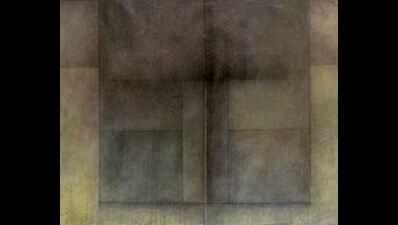
An untitled 2007 work done with mixed media on paper by the artist.

The abstractionist—occasionally referred to as Mumbai’s Mark Rothko—died on Thursday morning at the age of 87 in a city hospital. He had suffered a series of strokes and had stopped painting a few years ago. Gandhy, who has his last painting, says it’s not dark and brooding like his other works but much lighter. “It’s a beautiful canvas,” she says, describing both his work and personality as painfully precise. “He had a maddening sense of exactitude,” she says. “He even monitored how much cream and sugar went into your coffee.” His obsessive side came to the fore while setting up and lighting his artworks before a show. “It was never good enough especially in the early days before we had modern lighting,” she recalls.
Gobhai, who lived on Carmichael Road, and later Colaba, studied at St Xavier’s School, and learned drawing under the master draughtsman Shiavax Chavda. He went on to study at London’s Royal College of Art, The Art Students League of New York and the Pratt Graphic Centre (again, in New York City). He then took up a job at an advertising agency and worked as a children’s illustrator, before becoming a full-time artist. After two decades in NYC, he returned to Mumbai in the 1980s, which was when Gandhy first met him. She describes him as an “absolutely dashing man”, who was young in spirit, naughty and flirtatious despite being gay.
Gobhai, who mentored younger artists and was revered by his peers—Gandhy calls him an “artist’s artist”—was always “modest and self-deprecatory”, says art critic Girish Shahane. “He would look at other artists’ works with great interest, even those much younger than him and working in different genres. He didn’t believe the kind of abstraction he did had a superior claim,” adds Shahane. Artist Sheetal Gatani credits him with creating a “shift” in her work and personality. “Conversations with him made me a better painter and person,” she says.
His cousin Noshir Gobhai and cultural theorist Nancy Adajania both recall his sensitivity, kindness and love for animals. While Adajania recalls him nursing a crow with a broken wing for almost two years, Gobhai remembers how during the monsoon, he would stop to pick up snails, who had strayed onto the pavement where people would accidently crush them with their feet. He would gently wash them in a stream of rainwater and place them safely in the garden. “He needed to make things whole and perfect,” recalls Adajania in a Facebook post. “A line out of place, a mispronounced word, bad craftsmanship—all of this gave him a visceral ache. The perfect line, the perfect musical note made him ecstatic.”
End of Article
FOLLOW US ON SOCIAL MEDIA






Hot Picks
TOP TRENDING
Trending Stories
In City
Entire Website
- Malaika Arora's father Anil Arora dies by suicide in Mumbai
- 7 Key Reasons Why UPSC is the Toughest Exam in India
- 9/11 Remembrance Day: Key moments from the deadliest attack on US
- Howard University: 10 landmark firsts of the institution that shaped Kamala Harris
- Earthquake of magnitude 5.8 strikes Pakistan, tremors felt in Delhi, neighbouring areas
- Who were Barack Obama's challengers in 2008 and 2012 US presidential elections?
- 'A in INDIA alliance': Rahul Gandhi's slip-up during address to Indian-Americans goes viral
- Trump vs Harris: Betting markets reveal who’s expected to win the US presidential debate
- IGNOU December 2024 Term-End Exam: Registration Details, Important Dates, and Fee Structure
- Top 10 TED Talks to Boost Confidence and Success for Female Students
- Harris emerges unscathed from debate, dancing around her flip-flops
- After Kolkata docs set new demands, Mamata govt says 'not ready to accept'
- Is this India’s chance to replace Bangladesh as world’s clothing factory?
- 'They would be in jail if ...': Kharge's attack draws BJP's 'Emergency' retort
- The Multan Mystery: When Dravid left Tendulkar stranded at 194*
- Ayushman Bharat scheme to be expanded to cover elderly above 70
- Why is Kolkata rape-murder victim’s mother accusing Mamata of lying?
- iPhone 16 series launched: Complete features, price and how to pre-order
- Watch: PM Modi participates in Ganpati Puja at CJI's house
- MAGA's wild debate theories: Kamala's 'earphones' to 'witchcraft'

Popular Categories
Hot on the Web
Top Trends
Trending Topics
Deepika PadukoneMalaika Arora Father DeathArbaaz KhanJayram RaviAishwarya Rai BachchanSlat WaterWeight GainGOAT CollectionVikas Sethi DeathMalayalam ProducersIndia's Best Dancer 4Simi GarewalDilli BabuIndian National ParksLaung BenefitsVikas SethiiPhone 16Dubai Princess Sheikha MahraMG Windsor EvWordle Answer
Living and entertainment
Latest News
Manju Warrier expresses gratitude for birthday wishes: "Forever humbled and grateful"Jiiva and wife escape with minor injuries after a road accidentThe Zodiac Signs Most Naturally Inclined to HealingWhy Banyan trees survive for centuries and spread indefinitely?Telangana government pushes for increased flood relief from CentreShilpa Shetty and Raj Kundra spotted at the Siddhivinayak Temple; video insideNBA 2K25 locker codes September 2024: Locker codes revealed and know how to reveal themDonald Trump and Kamala Harris shake hands as they meet for first time on debate stage: Watch the 'awkward' momentBRS pushes for disqualification of turncoat MLAs after High Court rulingKamala may have won debate. But election is still too close to callPrince William’s commitment to a lasting marriage with KateVarun Dhawan shares unfiltered reaction to Janhvi Kapoor's 'Daavudi' song from 'Devara: Part 1': 'So freaking good...''On basis of fairness and equality': Bangladesh seeks good relations with India, says YunusJr NTR starrer 'Devara: Part 1' completes censorship formalities; receives UA certificateJalen Ramsey demands action against Miami Police following Tyreek Hill's pulled from car49ers RB Christian McCaffrey misses win over JetsWWE Superstar Blames the Company for Failing to Utilize Omos’ PotentialArbaaz Khan spotted outside Malaika Arora's house along with police after the tragic news of her father's demise by alleged suicide - WATCH VIDEO
Copyright © 2024 Bennett, Coleman & Co. Ltd. All rights reserved. For reprint rights: Times Syndication Service